Home / Solutions / API Security Testing

API Security Testing

Full penetration testing for your REST and GraphQL APIs. Register your API. Vortex does the rest.

APIs are your biggest attack surface and the hardest to test manually. Vortex maps your entire API, runs exploit-validated penetration tests across every endpoint, and generates the fix — automatically. Supports REST and GraphQL. Import your Swagger spec, Postman collection, or let Vortex discover your surface on its own.

OWASP API Top 10. 100% coverage. CREST certified.

vortex — api pentest — api.acmecorp.io LIVE
$ vortex api --import swagger.json --target api.acmecorp.io
[+] spec imported: 84 endpoints mapped (REST + GraphQL)
[+] auth configured: Bearer token (admin + standard user)
$ vortex api --phase exploit --auth multi-user
[~] TESTING GET /api/v2/users/{id} → IDOR attempt
[~] TESTING POST /api/v1/orders → mass assignment
[~] TESTING /graphql → introspection probe
[!] VULNERABLE — CONFIRMED: GET /api/v2/users/{id}
CRITICAL Broken Object Level Authorization
User A successfully accessed User B's records by modifying the ID parameter.
GET /api/v2/users/8842 → 200 OK (user_id: 8843's data returned)
$ vortex api --generate-fix

APIs are where attackers go first. Most security tools test them last.

Modern applications are API-first. Every feature ships as an endpoint. Every endpoint is an entry point. Authentication bypasses, IDOR chains, broken object-level authorization — these are the vulnerabilities that lead to the biggest breaches, and they're the ones most security programs test least thoroughly. Web application scanners are built for pages and forms. They miss the authorization failures, the business logic abuse, and the GraphQL-specific attack surface that make up the bulk of real API risk. And manual API pentesting — when it happens at all — is scoped once, run once, and obsolete the moment the next release ships.

01 / Problem

Authorization failures are the real risk

The OWASP API Security Top 10 is dominated by authorization failures — broken object-level authorization, broken function-level authorization, broken object property level authorization. Not injection. Not XSS. Authorization. An attacker who can access another user's data by changing an ID in a request doesn't need to exploit a CVE. They need to find the endpoint your scanner didn't test as an authenticated user.

02 / Problem

GraphQL is a different attack surface

GraphQL APIs expose a fundamentally different attack surface from REST. Introspection queries reveal your entire schema to anyone who asks. Nested queries can exhaust server resources. Field-level authorization is easily misconfigured. Batching attacks bypass rate limiting. Generic web scanners don't test any of this — because they weren't built for it.

03 / Problem

Your API changes faster than your tests

New endpoints ship with every release. New parameters get added. New authorization rules get implemented — sometimes incorrectly. A pentest from last quarter describes an API that no longer exists in the same form. Every release that goes untested is a window an attacker can walk through within hours of deployment.

Three ways to point Vortex at your API. Pick the one that fits.

Register your API as a target in the Vortex dashboard. Vortex maps the surface and begins testing. Three onboarding paths — use whichever matches how your API is documented.

Import your Swagger or OpenAPI spec

If your API has an OpenAPI / Swagger JSON spec, import it. Vortex reads every endpoint, method, parameter, and schema definition — building a complete attack surface map without any manual configuration. Every endpoint in the spec gets tested. Nothing is skipped because it wasn't discovered dynamically.

OpenAPI 3.x · Swagger 2.0

Import your Postman collection

Already have a Postman collection for your API? Import it directly. Vortex uses the collection as the test scope — including any authentication configuration, environment variables, and example requests you've already defined. That investment immediately becomes the foundation for a full pentest.

Postman Collection v2.x

Automatic discovery

No spec. No collection. Point Vortex at your API base URL and let it map the surface itself. Vortex crawls your API, discovers endpoints through active probing, infers parameters and methods, and builds the attack surface map dynamically. Useful for legacy APIs, third-party APIs, or any surface where documentation doesn't match reality.

URL · base path · auth token

The same four-phase pentest methodology. Built for APIs.

Vortex applies the same four-phase penetration testing approach to your API surface — reconnaissance, vulnerability scanning, exploitation and verification, and reporting — with attack techniques tuned specifically for how REST and GraphQL APIs get compromised.

PHASE 01

Reconnaissance

Map every endpoint, method, parameter, and schema before a single attack fires.

Vortex maps your complete API surface — every endpoint, HTTP method, parameter, authentication requirement, and response pattern. For GraphQL APIs, Vortex performs schema introspection to build a complete picture of every query, mutation, and type before a single attack payload fires.

endpoint discovery — api.acmecorp.io 84 routes
/api/v2/users/{id} GET · PATCH REST HIGH
/api/v1/admin/users GET · DELETE REST HIGH
/graphql POST GraphQL HIGH
/api/v1/orders/{id}/items GET · POST REST HIGH
/api/v2/invoices/export GET REST MED
/api/v1/auth/token POST REST MED
/health GET REST LOW

PHASE 02

Vulnerability Scanning

Attack payloads tuned for how APIs actually get compromised.

Vortex probes every endpoint with attack payloads tuned for API vulnerabilities — testing authorization logic across user contexts, injecting into parameters and headers, probing GraphQL fields for exposure, and checking every authentication flow for bypass opportunities.

api attack surface — scanning SCANNING
[~] IDOR probe: 84 endpoints × 3 user contexts
[~] Auth bypass: testing token manipulation flows
[~] Mass assignment: POST/PATCH body field injection
[!] Func-level auth: calling admin endpoints as std user
[~] GraphQL: introspection + field-level auth checks
[~] JWT: algorithm confusion, weak secrets, replay
[~] Rate limiting: batching bypass via GraphQL aliases

PHASE 03

Exploitation & Verification

Every potential finding is validated with a real exploit.

An IDOR finding is validated by actually accessing another user's resource. A broken function-level authorization finding is validated by successfully calling an admin endpoint as a standard user. If Vortex can't prove the exploit works, it doesn't report the finding.

vortex — exploit confirmed CRITICAL
Critical Broken Object Level Authorization
GET /api/v2/users/{id} → cross-user data access confirmed
Exploit request
GET /api/v2/users/8843 HTTP/1.1
Authorization: Bearer <user_8842_token>
→ 200 OK — returned user_8843's PII
CVSS score
9.1 (Critical) — CVSS:3.1/AV:N/AC:L/PR:L/UI:N
Exploit confirmed — fix PR ready

PHASE 04

Reporting

Complete evidence package. Mapped to compliance. Ready to act on.

Every confirmed finding arrives with the complete evidence package: the HTTP request used, the response that confirmed exploitability, the affected endpoint, the CVSS score, the OWASP API Top 10 category, and the developer-ready remediation guidance. Mapped to your compliance frameworks automatically.

Full technical methodology detail →
scan complete — api pentest report COMPLETE
3
Critical
5
High
19
Suppressed
CRIT Broken Object Level Authorization Fix ready
CRIT Broken Function Level Authorization Fix ready
HIGH GraphQL Introspection Exposed Fix ready

OWASP API Top 10. 100% coverage. Plus everything it doesn't include.

The OWASP API Security Top 10 defines the most critical API risks. Vortex covers all ten — with exploit validation on every finding, not just detection. Here's the full scope.

API1:2023
Broken Object Level Authorization
Accesses resources belonging to other users by manipulating object IDs in requests
API2:2023
Broken Authentication
Tests all authentication flows for bypass, brute force, token weakness, and session handling flaws
API3:2023
Broken Object Property Level Authorization
Tests for mass assignment and excessive data exposure at the property level
API4:2023
Unrestricted Resource Consumption
Tests rate limiting, pagination abuse, and resource exhaustion vectors
API5:2023
Broken Function Level Authorization
Calls admin and privileged functions as standard users — validates what's actually accessible
API6:2023
Unrestricted Access to Sensitive Business Flows
Abuses legitimate business workflows to extract value or data beyond intended scope
API7:2023
Server Side Request Forgery
Tests for SSRF via API parameters that accept URLs or network locators
API8:2023
Security Misconfiguration
Tests CORS policies, HTTP security headers, verbose error messages, and default configurations
API9:2023
Improper Inventory Management
Tests shadow APIs, deprecated endpoints, and undocumented versions that remain accessible
API10:2023
Unsafe Consumption of APIs
Tests third-party API integrations for injection and trust boundary failures
REST API Coverage
Additional attack classes beyond the OWASP Top 10
SQL injection via parameters NoSQL injection Command injection XXE via API payloads Insecure deserialization JWT algorithm confusion JWT weak secrets JWT missing validation OAuth flow attacks API versioning abuse Verbose error exposure HTTP method abuse
GraphQL-Specific Coverage
Attack surface unique to GraphQL — not tested by generic scanners
Introspection abuse Nested query attacks Field-level authorization failures Batching attacks Alias abuse Mutation testing Subscription abuse Type confusion attacks

The vulnerabilities that matter are behind the login.

The authorization failures covered above — BOLA, IDOR, broken function-level authorization — only surface when Vortex is operating as an authenticated user trying to access resources that belong to someone else. An unauthenticated test misses the bulk of real API risk.

Vortex tests your API across multiple user contexts: unauthenticated, standard authenticated user, privileged user, and cross-user access attempts. It tests what happens when User A tries to access User B's data. When a standard user calls an admin endpoint. When an authenticated request is replayed with a modified token.

The attack surface that matters is behind the login. Vortex tests all of it.

Method Use Case
Bearer token JWT and OAuth bearer token authenticated APIs
API key Key-based authentication via headers or parameters
Basic auth HTTP Basic authentication
Form / session Cookie-based session authentication
OAuth 2.0 Authorization code, client credentials, implicit flows
Custom headers Proprietary authentication header schemes

Found it. Proved it. Fixed it.

Every validated API finding comes with a developer-ready fix. Vortex generates the Jira ticket, opens the pull request, and writes the remediation guidance — specific to the vulnerability class and your technology stack. Your developer fixes it. Vortex retests. Finding closed.

01

AI Remediation Guidance

Stack-specific

Step-by-step fix instructions written for the specific vulnerability class — not a link to the OWASP documentation. For an IDOR finding, Vortex explains exactly how to implement object-level authorization checks in the context of your API framework. For a broken authentication finding, it walks through the token validation logic that needs to change. Specific to your stack. Actionable immediately.

02

Automated Jira Tickets

Every confirmed API finding creates a Jira ticket automatically — vulnerability title, severity, affected endpoint, HTTP method, the payload that confirmed it, business impact, and remediation steps. The ticket includes enough context that a developer can fix the issue without needing a separate briefing from the security team. Closed automatically when Vortex confirms the fix on retest.

Auto-closed on retest
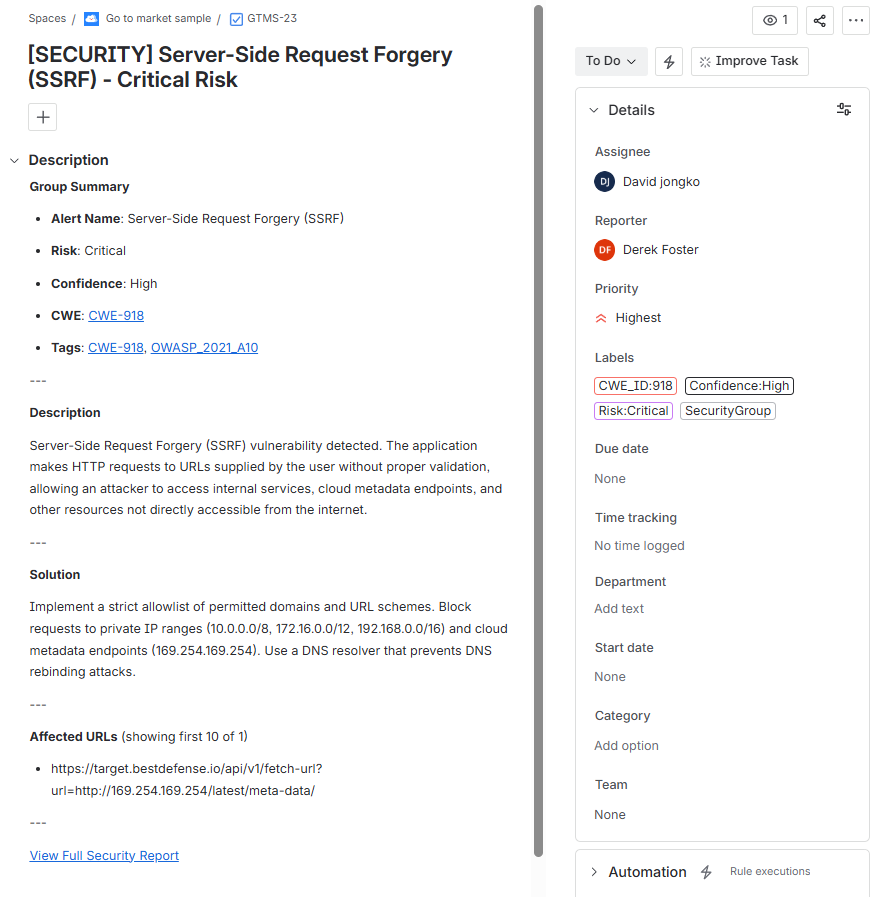
jira — SEC-312 — auto-created by vortex CRITICAL
Vortex-created Jira ticket for an API BOLA finding — auto-populated with severity, endpoint, HTTP method, exploit payload, and remediation steps

03

Auto-Fix Pull Requests

For common API vulnerability classes — authentication validation gaps, missing authorization checks, insecure deserialization — Vortex generates a pull request in your repository with the fix code already written. Your developer reviews the diff and merges. The vulnerability is closed. The fix is on record and linked to the finding.

GitHub · GitLab · Bitbucket
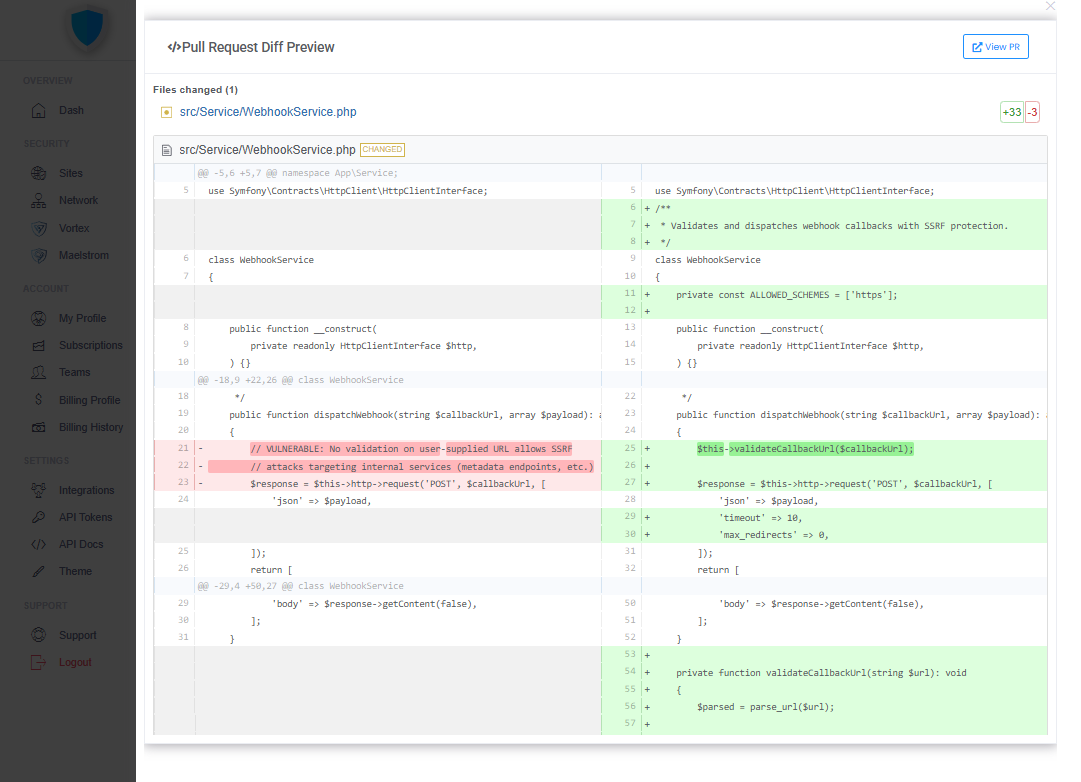
github — fix: object-level auth — users controller MERGED
Vortex-opened fix PR for a BOLA finding — diff showing added authorization check, merged badge visible

Test every API change before it ships. Or on a schedule. Both.

API surfaces change with every deployment. New endpoints. New parameters. New authorization logic — sometimes incorrectly implemented. Vortex runs automatically in your CI/CD pipeline on every commit, PR, or deploy — testing the API changes in that specific release before they reach production. It also runs on a continuous schedule, catching new CVEs published against your API dependencies and configuration drift between releases. Either mode, or both simultaneously.

Pipeline mode
Triggers on every commit, PR, or deploy. Tests the diff — new and changed endpoints in scope immediately.
Continuous / scheduled
Full surface re-tested on a schedule. Catches configuration drift and newly published CVEs between releases.
Full CI/CD integration detail →
github actions — vortex api scan PASSING
import openapi spec 0.4s
endpoint diff — 3 new routes detected 1.2s
auth configuration loaded 0.3s
api pentest — 3 new endpoints in scope running
···
exploit validation pending
···
generate findings + fix PRs pending

APIs are the most exploited attack surface. Vortex tests them like an attacker would.

100%
OWASP API Top 10 coverage
exploit-validated, not detected
90%
Fewer alerts
only confirmed API vulnerabilities surface
REST + GraphQL
Two API types, one platform
purpose-built for both
3
Ways to onboard
Swagger · Postman · auto-discover
"

BestDefense.io helped us find critical vulnerabilities and helped to drastically reduce the amount of time to resolve them through their automated workflows. This allowed us to secure enterprise customers who required we had a 3rd party audit.

Thariq Kara
BiteData.io

Your API is the attack surface attackers target first.

See what Vortex finds in your API. Import your spec and we'll run the first test in the demo.

We'll import your Swagger spec or Postman collection, map your API surface, and run Vortex against it live. You'll see real validated findings from your actual API — not a staged walkthrough. REST, GraphQL, or both.

Supports REST and GraphQL. Swagger, OpenAPI, and Postman import. OWASP API Top 10 — 100% coverage. CREST certified.