DevSecOps & CI/CD Security
Vortex runs DAST on every commit, PR, and deploy — automatically. Findings go straight to your developers. Fixes ship as pull requests. No new process. No security backlog. Just security that works the way your team already does.
CREST certified. · Trusted by BiteData, NCOG, Hyacinth, and others. · Works with GitHub, GitLab, Bitbucket.
The Problem
Security tickets land in a backlog with no context, no clear fix, and no urgency. They get triaged eventually — if the sprint has room.
Your CI/CD pipeline is fast. Most security scans run separately, on a schedule, after the fact. The gap between commit and detection is where attackers operate.
Every hour validating false positives is an hour not spent on real threats. When developers can't trust the scanner, they stop looking at it.
You're two lines of YAML away from none of this.
How It Works
Vortex triggers on every commit, pull request, or deployment — no manual scan to kick off.
Every finding is exploit-validated before it surfaces. Your team sees confirmed vulnerabilities only — not a noise list.
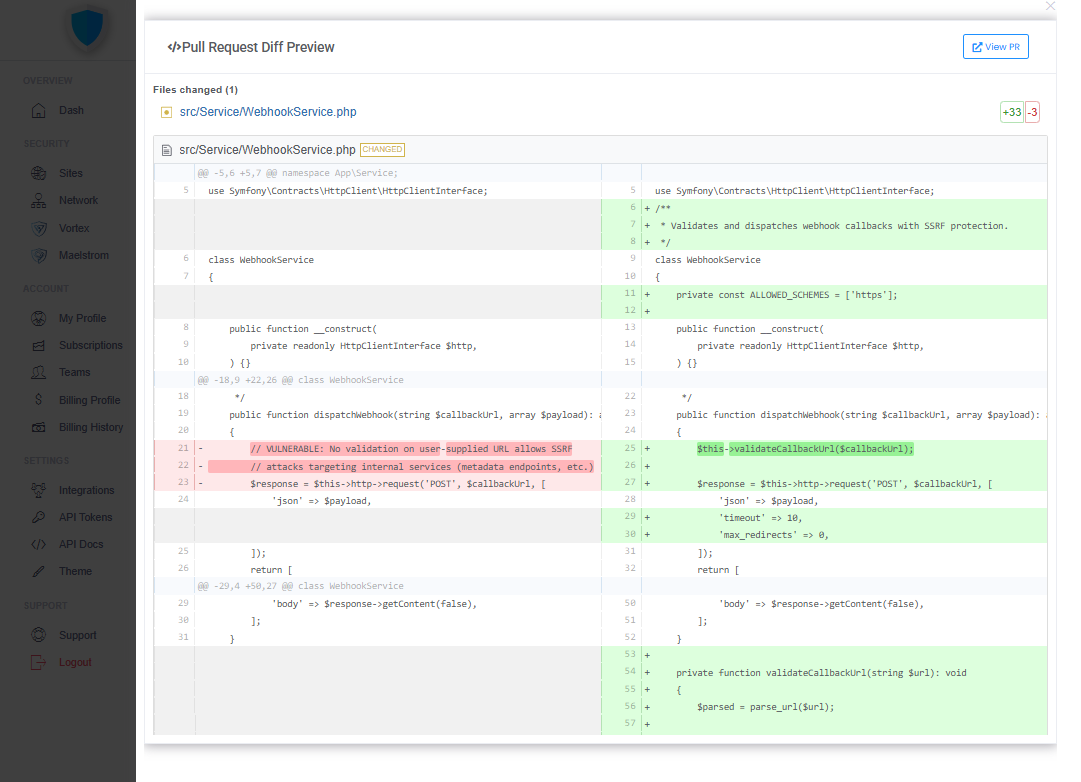
Critical findings block the build. Vortex generates the fix as a pull request. Your developer reviews, merges, done.
Integrations
Zero new tools to learn. Zero workflow changes.
Setup
Add Vortex to your GitHub Actions workflow. Scans trigger automatically on every push or pull request.
# Add to any existing workflow jobs: security: runs-on: ubuntu-latest steps: - uses: actions/checkout@v4 - name: Vortex Security Scan uses: bestdefense/vortex-action@v1 with: api_key: ${{ secrets.VORTEX_API_KEY }} target_url: ${{ env.STAGING_URL }} block_on: critical
Developer Experience
Vortex doesn't ask your developers to learn a new tool. Findings appear as PR comments, Jira tickets, and Slack alerts — in the context where developers are already working.
Category
Dynamic Application Security Testing (DAST) runs real attack payloads against your live application — the same way an attacker would. Unlike static analysis (SAST), it doesn't scan source code. It tests what actually happens when the app runs: auth bypasses, broken access controls, injection flaws, business logic abuse. Vulnerabilities that only exist at runtime can't be caught any other way.
Auth bypasses, broken access controls, and business logic flaws only exist at runtime. If your scanner never runs the app, it never finds them. SAST can't see what isn't in the source.
DAST tests with real attack payloads against your running app. If a finding surfaces, it's because the exploit worked — not because a code pattern matched. No false positives to chase.
In a pipeline, DAST runs on every build. A vulnerability introduced on Monday is caught before it ships on Tuesday. The window between commit and detection closes to minutes.
Proof
After implementing BestDefense, we cut our vulnerability detection time by 60% while keeping our deployments on track. I'm finally able to focus on strategic security initiatives instead of constant firefighting.
Built for how developers actually ship.
We'll connect to your repo, trigger a real scan, and show you findings and fixes in your actual environment. Not a staged walkthrough. Real results from your codebase.
Free first scan. No credit card. SOC 2 pending.