Home / Solutions / Network Security Testing

Network Security Testing

Network security validation that tests like attackers do — without breaking production.

Vortex continuously validates your network security controls from the attacker's perspective — inside your live network, with no endpoint agents, no firewall changes, and no production downtime. Built by a team with decades of experience securing petabyte-scale infrastructure for NASDAQ, NYSE, Worldpay, and Chase Bank.

Trusted by BiteData, NCOG, Hyacinth, and others. Backed by Techstars.

network scanning architecture — vortex SCANNING
ISP / Enterprise Network Environment
BD Network Scanning Agent
Inside network perimeter
Active vulnerability tests
Web Servers
Databases
Network Devices
Branch / IoT
Findings & evidence
BD Reporting Platform QoD: 94%

Security audits happen once or twice a year. Attackers test networks every single day.

Between audits, most organizations lose visibility into four things:

Configuration drift Branch and remote locations accumulate changes between visits. Most drift goes undetected until the next audit.
Newly introduced vulnerabilities Routine patches and updates create new exposure. The window between update and validation is where attackers operate.
Default credentials Newly connected devices go live with factory defaults. Most organizations don't know they exist until they're compromised.
Transient exposures Some vulnerabilities appear and disappear between scans — open ports, misconfigured services, temporary access rules that become permanent.
Most organizations know continuous network security validation is best practice. Few have been able to afford the tools, teams, and complexity to do it well. BestDefense changes that.

Deploy once. Test continuously. Validate everything.

Vortex operates inside your network — not from the outside looking in. That's what makes findings defensible: the agent sees your network the same way an attacker inside it would.

STEP 01 — DEPLOY

Up and running in minutes. Nothing to maintain.

The BestDefense network scanning agent deploys within your network environment — on-premises or in your ISP/hosted environment.
No endpoint agents on monitored devices
No credentials required
No firewall rules to add or modify
No inline enforcement of any kind
agent status ● Active
10.0.0.0/24 Main site In scope
192.168.10.0/24 Branch A In scope
172.16.5.0/24 Remote site In scope

STEP 02 — TEST

Continuous black-box testing across your entire attack surface.

Vortex tests network-reachable services the way an attacker encounters them — from outside each system boundary, with no prior knowledge of what's running. Branch offices, remote sites, IoT devices, and edge infrastructure are all in scope. New devices added to the network are discovered and tested automatically.
device discovery — live 47 hosts
10.0.1.105 Web Server Scanning
10.0.1.22 Database Scanning
192.168.10.1 Router Scanning
172.16.5.88 IoT Device New — added 2h ago

STEP 03 — VALIDATE & REMEDIATE

Only confirmed, network-reachable findings reach your team.

Every potential finding goes through active verification before it surfaces. Vortex confirms the vulnerability is actually reachable and exploitable from the network — not just theoretically present. Each confirmed finding includes a confidence score (QoD: Quality of Detection, rated 0–100%), the network path evidence, the CVE reference, and remediation guidance.
vortex — finding detail
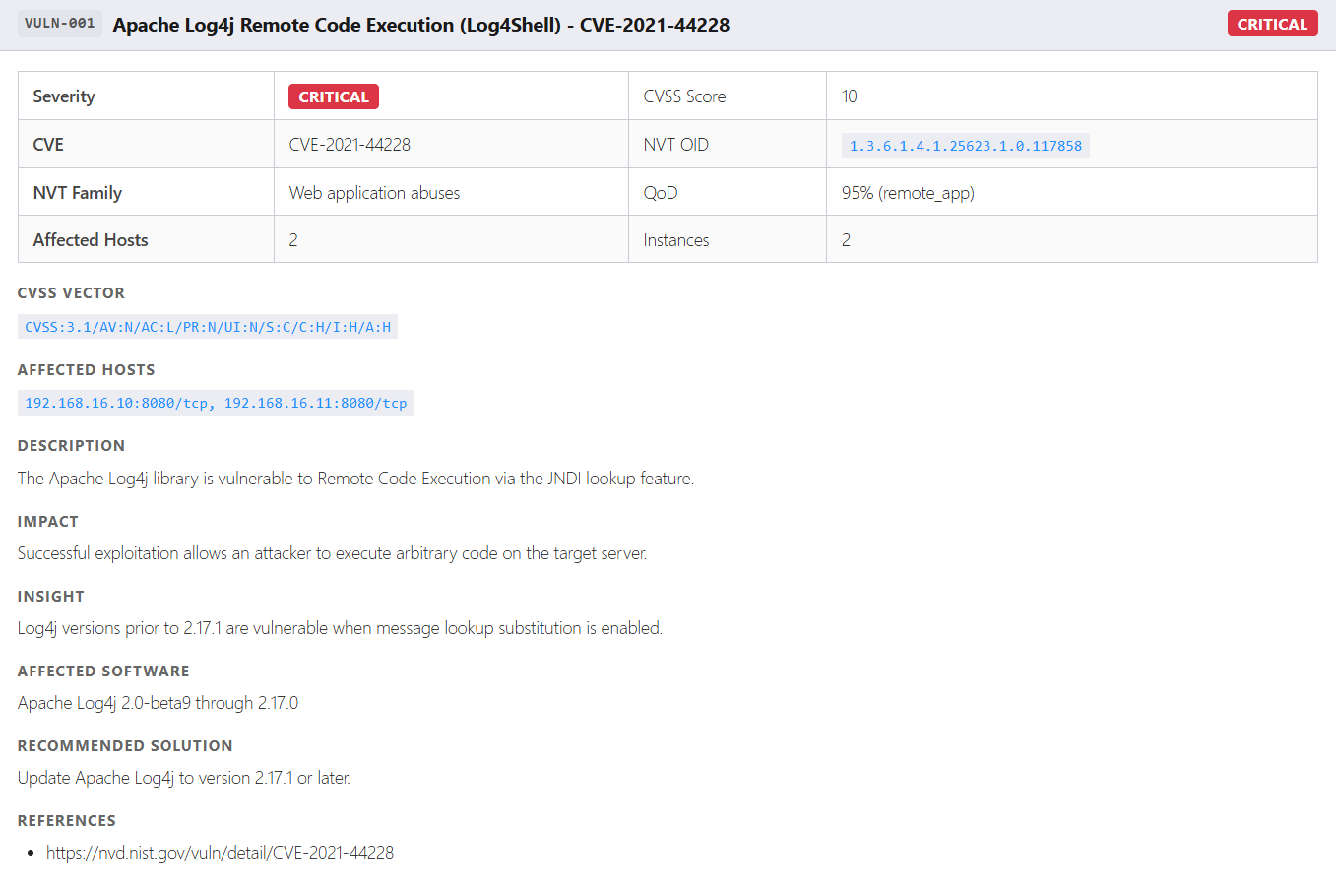
Vortex finding detail — QoD score, network path evidence, and remediation guidance

Built to run in live production networks.

Vortex was designed for high-availability environments. Every testing decision — what to run, how hard to push, what to skip — is controlled. Here's exactly how.

96%

Passive by Default

The overwhelming majority of Vortex tests are passive and information-gathering. Active exploit checks are used only when passive reconnaissance has already confirmed exposure. The agent is not aggressive by default.

passive first

Active Checks Only When Exposure Is Confirmed

Vortex does not attempt to exploit a service before confirming it's reachable and likely vulnerable. Active verification is gated: passive reconnaissance first, active check only if the exposure is confirmed. This keeps test impact minimal while ensuring findings are real.

gated escalation

Zero Inline Enforcement

Vortex has no inline position in your network. It does not intercept, inspect, or modify traffic. There is no path for the agent to disrupt network operations — it only tests, it never enforces.

test only, never enforce

Destructive Tests Require Explicit Approval

Any test that could cause service disruption is disabled by default. Destructive checks must be explicitly enabled and scoped by your team before Vortex will run them. You control the ceiling on test aggression.

opt-in only

18,000+ tests across every layer of your network.

Vortex covers the full network stack — from web applications and operating systems to databases, SSL/TLS configurations, and IoT devices. Every category is tested with purpose-built checks, not generic CVE lookups.

7,800+
Web Application Tests
CMS platforms, web servers, XSS, SQLi, CSRF, and PHP/CGI vulnerabilities
WordPress Joomla Drupal Apache Nginx
6,000+
Operating System Tests
Linux distributions, Windows patch verification, and OS-level misconfigurations
Ubuntu Debian RHEL CentOS Windows
2,000+
Network Service Tests
Protocol-specific vulnerabilities across core network services
SSH FTP SMTP DNS RDP SMB Telnet
1,863
Database Tests
Authentication bypass, injection, and default credential checks
MySQL PostgreSQL Oracle MS SQL
916
SSL/TLS Tests
Weak ciphers, certificate issues, and legacy protocol vulnerabilities
Heartbleed POODLE BEAST Weak ciphers
386
IoT & Network Device Tests
Routers, IP cameras, printers, and default credential checks
Cisco D-Link Netgear IP cameras

Six categories of network-level risk. All covered.

Every major class of network exposure, tested continuously — not once a year.

Outdated software with known CVEs
Misconfigurations (weak SSL, open services)
Default credentials
Missing security patches
Web application vulnerabilities (OWASP Top 10)
Certificate issues

Turns network vulnerability scanning into continuous, evidence-backed validation.

The operational, compliance, and security outcomes your team needs — from a single continuous deployment.

Security Value
Fewer false positives
Only network-reachable, exploitable findings surface. Vortex doesn't report vulnerabilities it can't confirm — confidence scoring filters out noise before it reaches your team.
Clear prioritization
Every finding carries a QoD confidence score. Your team works the high-confidence findings first. Low-confidence findings are logged and available but don't create alert fatigue.
Continuous validation
Configuration drift, newly connected devices, and new vulnerabilities introduced by routine updates are caught as they appear — not six months later at the next audit.
Compliance Benefits
Evidence auditors trust
Every finding includes network path evidence, CVE references, confidence scoring, and timestamps. This is not a scanner report. It's defensible evidence built for audit review.
Always-ready posture
Compliance evidence accumulates continuously. When your audit arrives, the evidence package is already structured and ready to export. No pre-audit scramble.
Defensible findings
Every finding is based on actual network exposure, not theoretical risk. When an auditor asks "how do you know this is real?" — the network path evidence answers the question.
Operational Impact
Less time per finding
Confidence scoring and exploit validation mean your team focuses on what matters. Time spent triaging a 300-item alert list drops to reviewing a short list of confirmed, prioritized findings.
Scales across locations
Vortex supports multiple simultaneous locations — main site, branch offices, remote sites, and customer environments — from a single deployment. No per-site configuration required.
Fits your existing workflow
Findings integrate with your current remediation and ticketing tools. Vortex doesn't require you to change how your team works — it surfaces findings where your team already operates.

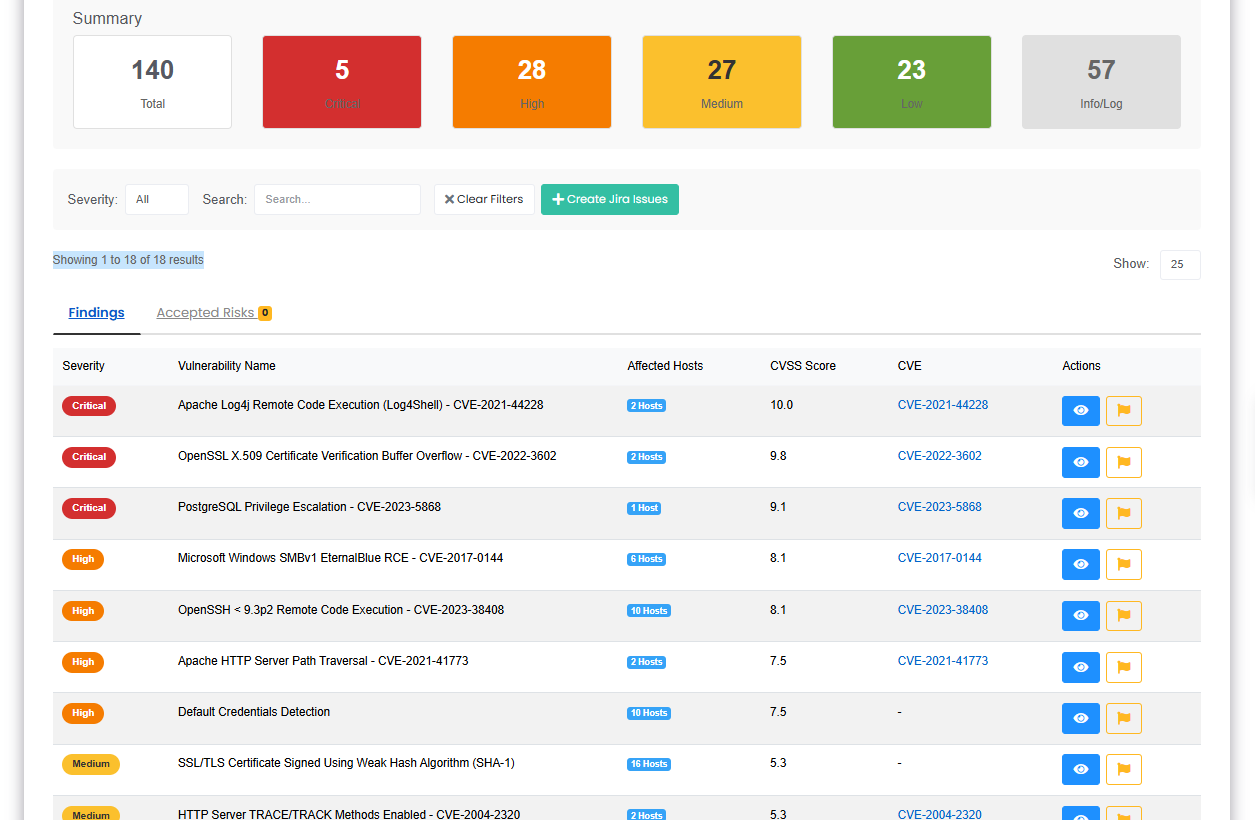
What your team opens after every scan.

Prioritized findings, QoD confidence scores, network path evidence, and compliance tags — all in one view. Ready for your team and ready for your auditors.

vortex — findings dashboard
Vortex findings dashboard — prioritized findings with QoD scores and compliance tags
EdTech · $100M ARR · Distributed Platform · SOC 2 & student data compliance

The problem wasn't visibility — it was too much visibility.

Challenge
Over-scoped attack surface from periodic scanning
High volume of low-confidence findings creating alert fatigue
Needed defensible audit evidence without increasing operational load
90%
Reduction in alerts
85%
Faster remediation
90%
Faster scoping

Eight questions your team will ask. Answered directly.

If you're evaluating a network security tool for a regulated environment, these are the questions that matter.

Is this active testing or monitoring?
Active testing. Vortex performs continuous, black-box network vulnerability testing against reachable services. It is not a monitoring, IDS, or NDR tool.
Does this require credentials or endpoint access?
No endpoint agents are required on monitored devices. Credentialed access is optional — and when used, it is explicitly scoped.
Will this disrupt network operations?
No. Low-impact tests run by default. There is no inline enforcement, no traffic interception, and no endpoint agents. The agent tests — it does not enforce.
What kind of reporting is produced?
Evidence-backed findings with CVE references, confidence scoring, and network path context — structured for both remediation workflows and audit review.
How is scan impact controlled?
Testing behavior is scoped and controlled. Destructive checks are disabled by default and must be explicitly approved before Vortex runs them. You can scope tests to specific devices, multiple subnets, or your full network.
What doesn't Vortex cover?
Source-code analysis, business logic flaws, social engineering, physical security, and traffic monitoring. Vortex focuses exclusively on network-reachable risk. For application and API security, see our Software Security Testing page.
Where is the agent deployed?
Within your network environment — on-premises or within your ISP/hosted environment. The agent tests network-reachable assets from an attacker's perspective, inside the network perimeter.
Who is this best suited for?
Organizations with complex or distributed networks that want continuous validation, fewer false positives, and defensible security evidence — particularly those with compliance requirements under SOC 2, NIST CSF, or CMMC.

Stop auditing. Start validating.

See what's actually exposed in your network. Right now.

We deploy inside your environment and run the first test during the demo. You'll see real findings from your actual network — not a canned walkthrough. Most teams find something on the first scan they didn't know was there.

Built by the team that secured NASDAQ, NYSE, Worldpay, and Chase Bank.