Home / Solutions / Continuous Penetration Testing

Continuous Penetration Testing

Penetration testing that runs every day. Not once a year.

Vortex continuously tests your applications, APIs, and networks using the same application and network attack techniques a skilled human pentester uses — automatically, against your live environment, 365 days a year. Every finding is exploit-validated. Fixes ship as pull requests, ready to review.

Trusted by BiteData, NCOG, Hyacinth, and others. 85% faster remediation than traditional pentest cycles. Audit evidence generated automatically.

12-month security coverage Live comparison
Annual Pentest Gap: 9+ months untested
Jan
Feb
Mar
Apr
May
Jun
Jul
Aug
Sep
Oct
Nov
Dec
Untested
Mar — Engagement starts
Apr — PDF delivered
Fixes? — next year
Vortex Continuous 365 days covered
Jan
Feb
Mar
Apr
May
Jun
Jul
Aug
Sep
Oct
Nov
Dec
Finding
Validated
Fixed
Retested

The Problem

Your last pentest told you about a version of your product that no longer exists.

The traditional penetration testing cycle is: scope the engagement, wait for the firm to schedule, wait for testing to complete, receive a PDF, triage a backlog of findings, assign tickets, wait for developers to fix them, manually retest. By the time that loop closes, the codebase has shipped dozens of times. The pentest describes a product your team stopped building three sprints ago.

01

The gap is longer than you think.

The time from pentest engagement to remediated, retested findings can stretch to six months or more. In that window, your team has shipped hundreds of changes. New features. New endpoints. New dependencies. The attack surface the pentest assessed has been replaced by one the pentest never saw.

02

Findings without fixes are just a list.

A pentest report hands your team a list of vulnerabilities. It does not tell your developers how to fix them in the specific framework they're using. It does not open a ticket in their workflow. It does not retest after the fix is merged. The gap between "we found it" and "it's actually fixed" is where AppSec findings become permanent tech debt.

03

Compliance evidence shouldn't require a scramble.

Most teams pull together penetration testing evidence for audits by exporting the PDF and hoping nothing has changed since it was produced. Auditors today want proof that vulnerabilities were found, validated, fixed, and retested — not a static report with a date on it.

What It Actually Is

Continuous pentesting means something specific here.

Running a vulnerability scanner on a schedule is not penetration testing. Penetration testing means simulating how an attacker thinks and operates — probing for real vulnerabilities with real payloads, chaining findings into exploit paths, and confirming what's actually exploitable rather than what's theoretically possible.

Continuous pentesting means doing that automatically, against your current environment, every time your application changes. Not against a snapshot. Not against a staging environment that may not reflect production.

Against the version of your product that's live right now.
Real attack simulation, not signature matching
Vortex uses AI-driven attack techniques — the same methods a skilled human pentester applies. It probes your application the way an attacker would: testing authentication flows, chaining vulnerabilities, abusing business logic, and constructing payloads specific to your stack. If a human pentester would try it, Vortex tries it.
Exploit validation, not probability
Every potential finding is validated with a real exploit attempt before it reaches your team. If Vortex can't prove the vulnerability is exploitable — with a real payload, against your real environment — it doesn't report it. What your team sees is a short list of confirmed, proven vulnerabilities. Not a probability distribution. Proof.
Always testing the current version
A traditional pentest is a snapshot. The day after the report, your team ships new code and the snapshot is obsolete. Vortex runs against every deployment — triggered by commits, pull requests, scheduled intervals, or on demand. The attack surface map updates with every scan. There is no gap.

Methodology

The same techniques. Running continuously.

Vortex follows the same four-phase approach a professional penetration tester uses — reconnaissance, vulnerability scanning, exploitation and verification, and reporting. The difference is it runs this workflow automatically, on every change, without a scheduling call or a statement of work.

Phase 01
Reconnaissance

Vortex maps your attack surface before testing begins — endpoints, authentication flows, API routes, and user-facing components. The map updates on every scan. New endpoints introduced in the latest deployment are in scope for the next run. Nothing goes untested because it was added after the last engagement.

Phase 02
Vulnerability Scanning

Vortex runs a coordinated battery of 20+ specialized tools simultaneously — covering injection attacks, authentication flaws, broken access controls, server-side vulnerabilities, and modern API attack classes.

50,000+
CVE checks per scan
5,000
CVE checks per minute (peak)
20+
Specialized tools
Phase 03
Exploitation & Proof

Every potential finding is validated with a real exploit attempt. SQL injection findings are validated by demonstrating data extraction is possible. Authentication bypass findings are validated by confirming unauthorized access can be gained. XSS findings are validated by executing the injected payload. If the exploit succeeds, the finding is confirmed. If it fails, it's suppressed. Your team never sees unvalidated findings.

Phase 04
Reporting

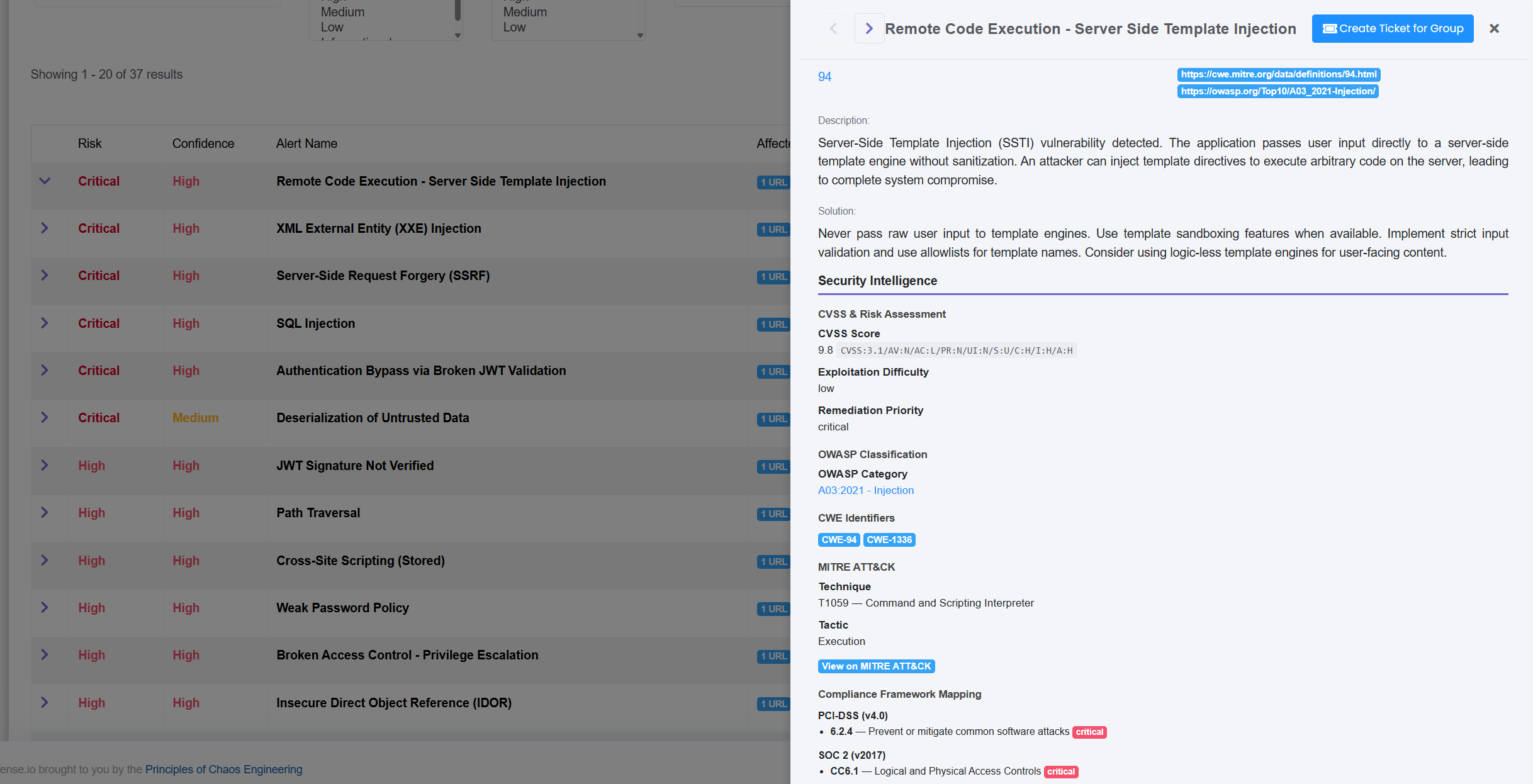
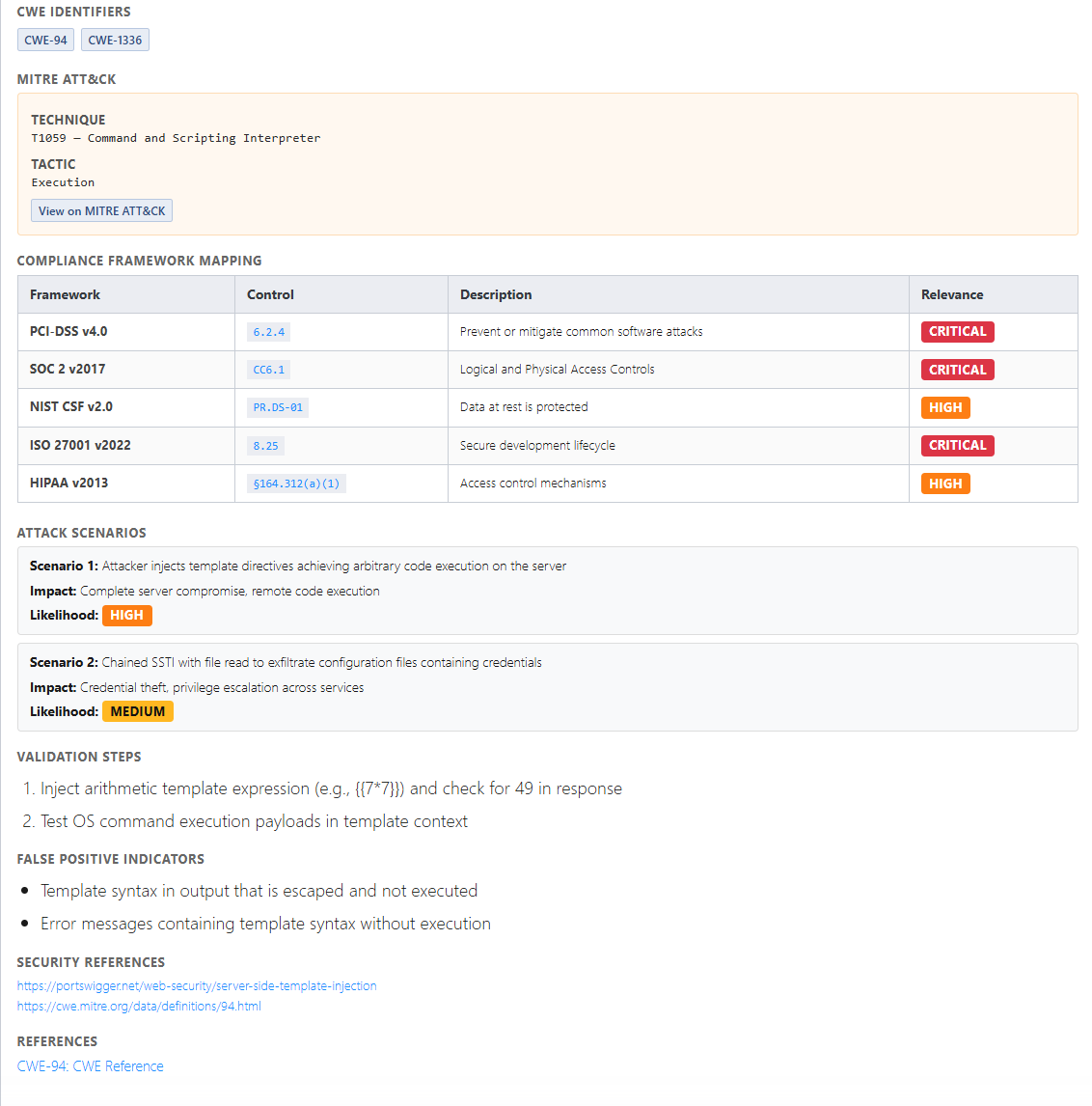
Every confirmed finding comes with a complete evidence package: the vulnerability, the exploit payload used, proof of access, the CVSS score, the MITRE ATT&CK mapping, the OWASP category, and the compliance control mappings. Remediation guidance is specific to your environment and technology stack — not a link to a CVE page. Available in real time, not weeks after the engagement closes.

See full technical detail →
app.bestdefense.io / findings / continuous Live dashboard
Vortex continuous pentest findings dashboard showing real-time validated findings with CVSS scores, exploit payloads, MITRE ATT&CK mappings, and fix PRs
Ready to see what Vortex finds in your environment? Get a Demo →

Your Choice

Your pentest program. Your call.

Every security program is different. Some teams are ready to move fully to continuous automated testing. Others want to keep their annual engagement and use Vortex to close the gaps between them. Both are valid. Both are supported.

Path A

Replace the Annual Pentest

Vortex covers the application and network testing scope of a traditional annual pentest — and then keeps running for the other 364 days. Reconnaissance, vulnerability scanning, exploitation verification, and remediation guidance run continuously against your live environment. You get findings faster, fixes sooner, and an always-current evidence package for auditors.

Best for
Teams that are comfortable with automated security testing, ship frequently, and need continuous assurance rather than a periodic audit event.
What you stop paying for
Scoping calls. Scheduling delays. Waiting weeks for a report. Manual retesting after fixes.
Path B

Run Alongside Your Annual Pentest

Keep your existing engagement for the deep human expertise and social engineering coverage that automated tools don't replace. Run Vortex continuously between engagements to catch what ships after the pentesters leave. By the time your next annual engagement starts, you've already found and fixed the common vulnerabilities — leaving human time for the harder, higher-value work.

Best for
Teams in highly regulated environments, those with compliance mandates that require a human-led pentest attestation, or organizations that want both continuous coverage and human expert validation.
What you gain
365 days of coverage instead of one engagement. A cleaner attack surface for human pentesters to work from. Evidence that your security posture is active, not periodic.

Output

Real-time findings. Not a report you read once.

A traditional pentest delivers a document. Vortex delivers a living security program. Here's what the output actually looks like.

Traditional Pentest Report Vortex Continuous Output
Delivery Weeks after testing Available in real time, per finding
Format Static PDF or Word document Live dashboard, always current
Currency Findings as of the test date Findings against today's live environment
Retesting Manual retesting required Automatic retesting after every fix
Fix guidance No fix guidance for your specific stack AI-generated fix guidance and fix PRs ready to review
Compliance Evidence requires manual export Audit evidence generated automatically per finding
Next update Same time next year Next deployment

The PDF had a date on it. Vortex has a timestamp on every finding.

Compliance

Audit evidence as a byproduct. Not a project.

Your auditor doesn't want a PDF from last April. They want proof that your security testing is continuous, your findings are validated, and your fixes are documented. That's what Vortex produces. Automatically. Every day.

Every test Vortex runs is logged with a timestamp. Every finding is stored with the full evidence package. Every fix and every retest is recorded. Findings are automatically mapped to the compliance controls they satisfy — so when your auditor asks for proof that you tested for SQL injection last quarter, you're not exporting logs from three different tools. You're clicking export.

app.bestdefense.io / compliance / evidence Audit ready
Vortex compliance evidence screen showing SOC 2 control mappings, timestamped findings, and one-click export for auditors
Framework Coverage
OWASP Top 10 100%
SANS Top 25 100%
PCI DSS 4.0 Web application controls
SOC 2 Type II CC6, CC7, CC8
ISO 27001 2022 A.12, A.14, A.18
NIST CSF 2.0 Detect, Respond, Recover
HIPAA Technical safeguards
CMMC Level 2 AC, SI, CA domains

* Specific control IDs subject to verification with engineering before publish. OWASP and SANS percentages confirmed from product documentation.

Results

What our customers actually get.

85%
Faster remediation vs. traditional pentest cycles
from customer results
100%
Of reported findings are exploit-validated
not probable — proven before it reaches your team
95%
Reduction in attack surface scoping time
from customer results
"

BestDefense.io helped us find critical vulnerabilities and helped to drastically reduce the amount of time to resolve them through their automated workflows. This allowed us to secure enterprise customers who required we had a 3rd party audit.

Thariq Kara
BiteData.io
"

BestDefense.io helped us validate our blockchain under real-world stress and accelerated our SOC 2 compliance. A true top-tier cybersecurity partner.

RJ Randall
NCOG

Stop waiting for the next engagement.

See what Vortex finds in your environment today. Not in six months.

We'll run a live test against your application or network during the demo — not a canned walkthrough. You'll see real validated findings from your actual environment, with fixes ready to review. Most teams find something on the first run they didn't know was there.

No credit card required for first scan. SOC 2 pending. Backed by Techstars.