Compliance & Audit Readiness
BestDefense is CREST certified. Our pentest reports have been accepted by auditors across SOC 2, ISO 27001, PCI DSS, HIPAA, NIST CSF, CMMC, and GDPR. Every finding Vortex surfaces is exploit-validated, timestamped, mapped to the relevant compliance controls, and ready to export — as a byproduct of continuous security testing, not a project you run before the audit.
Accepted by auditors. CREST certified. SOC 2 pending.
| Finding | Severity | Status | Discovered | Controls (all frameworks) |
|---|---|---|---|---|
| SQL Injection — /api/users | CRIT | Resolved | 2026-03-08 09:14 | |
| Broken Auth — JWT none alg | CRIT | Resolved | 2026-03-08 09:31 | |
| SSRF — image proxy endpoint | HIGH | Resolved | 2026-03-10 14:02 | |
| Missing rate limiting — /login | MED | Open | 2026-03-14 11:47 |
The Problem
The typical compliance evidence workflow: export logs from three disconnected tools, manually map findings to controls, pull the pentest report from last quarter and hope nothing critical has changed, write up remediation notes by hand, and send the auditor a spreadsheet and a prayer. Auditors today want more than that. They want proof that vulnerabilities were found with a validated methodology, confirmed as exploitable, fixed with documented remediation, and retested to confirm closure. That's a much higher bar than a CVE list and a PDF.
01
Security testing happens in one tool. Findings are tracked in another. Tickets live in Jira. Retest evidence is in a spreadsheet. By the time audit season arrives, assembling a coherent evidence package means pulling artifacts from five places and hoping the timestamps line up. Every piece of that process is manual, error-prone, and time-consuming.
02
A scanner report showing a list of CVEs is not penetration testing evidence. Auditors for SOC 2, PCI DSS, and ISO 27001 increasingly require proof of exploitability — not just detection. A finding that says "SQL injection possible" is not the same as a finding that says "SQL injection confirmed — attacker-controlled data extracted from the users table." The bar has moved. Most tools haven't.
03
Annual compliance reviews create annual compliance sprints — four weeks of frantic evidence gathering before the audit window. Then the audit passes, the team exhales, and the cycle resets. Security posture is strong in March. No one knows what it looks like in September. Auditors are starting to notice.
What Changes
Every test Vortex runs produces a timestamped log. Every finding is stored with the full evidence package. Every fix generated and every retest performed is recorded automatically and mapped to the relevant compliance controls. A report is generated the moment the test completes — as fast as 15 minutes for a focused app, up to 48 hours for a large network. When your audit window opens, your evidence package is already built. You export it. You hand it to your auditor. Done.
Compliance evidence accumulates continuously — every scan, every finding, every fix, every retest. There is no pre-audit sprint because there is no gap to fill. The evidence package reflects your current security posture, not your posture from the last time you ran a test.
Every finding in the evidence package is based on actual exploitation — not theoretical risk. When your auditor asks "how do you know this was real?" the answer is the payload, the response, the data accessed, and the confidence score. Exploit-validated findings are defensible findings.
The moment a test completes, a full CREST-certified report is generated — no trigger, no request, no waiting. Fastest tests finish in 15 minutes. Largest environments take up to 48 hours. Either way, when it's done you have a complete report with all findings, all control mappings, and all evidence included. The report exists before you think to ask for it.
The Evidence Package
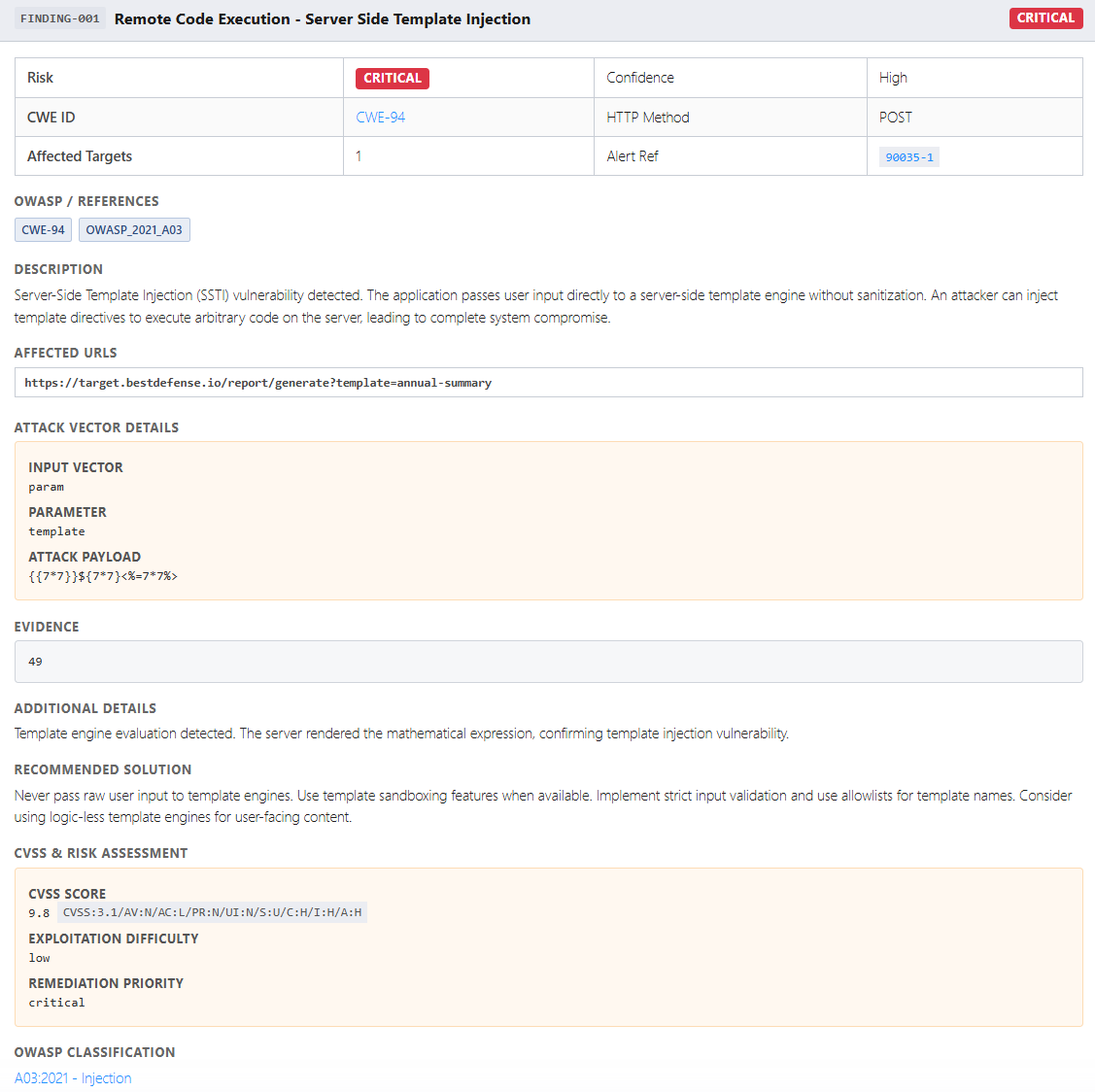
Every finding Vortex surfaces includes a complete evidence package. Not a summary. Not a CVE reference. The full record — from discovery to remediation to retested closure. Here's exactly what's in it.
| Field | What It Contains |
|---|---|
| Vulnerability detail | Name, risk level (Critical / High / Medium / Low / Informational), affected endpoint, HTTP method, parameter |
| Exploit evidence | The exact payload used, the response captured, data accessed (if any) — proof the vulnerability was confirmed, not assumed |
| CVSS score & vector | Numeric score + full CVSS 3.1 vector string — the standard scoring format auditors and QSAs recognize |
| CWE classification | Common Weakness Enumeration ID with reference link |
| OWASP category | Mapped to OWASP Top 10 category — the framework most web application audits reference |
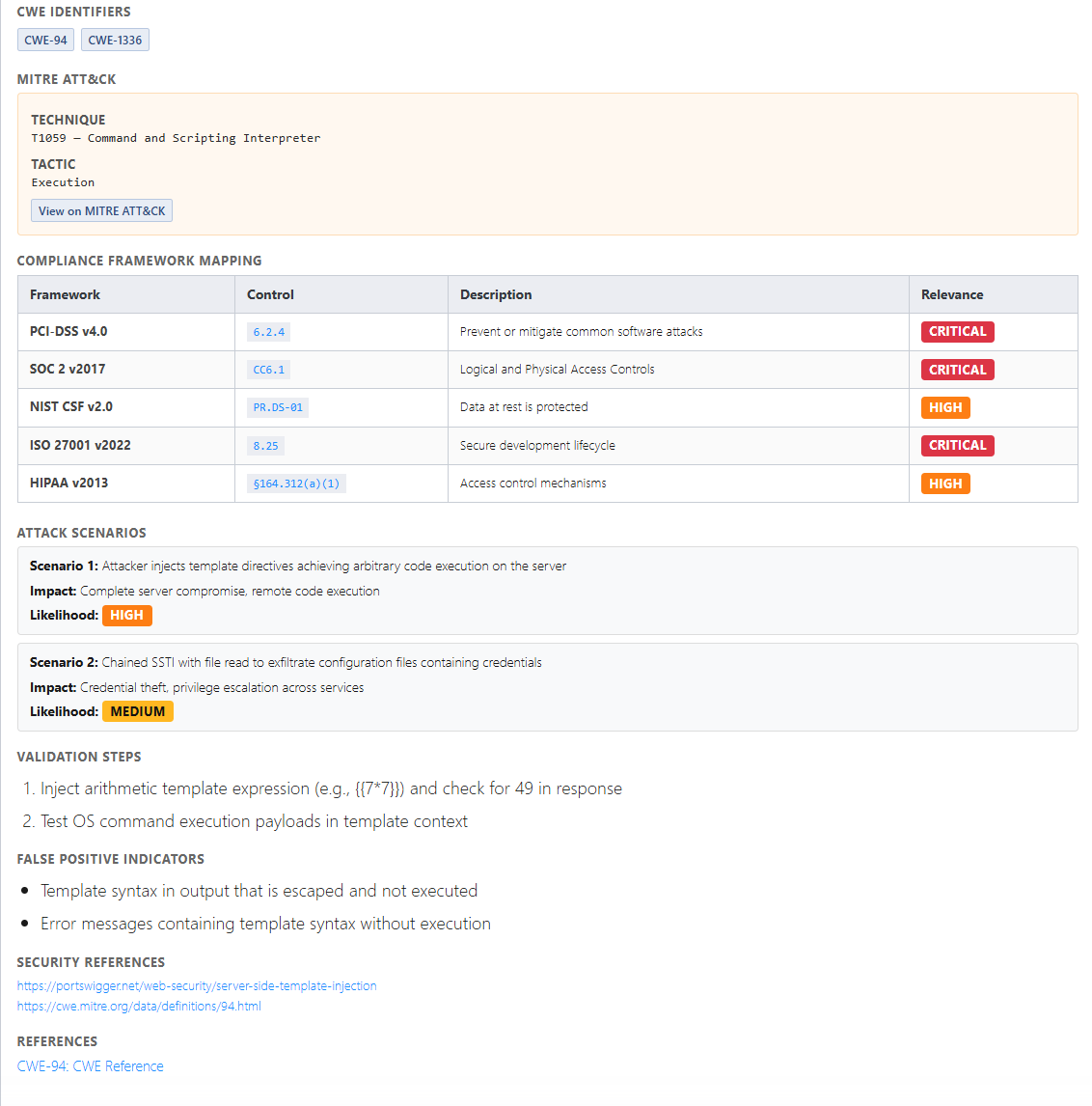
| MITRE ATT&CK mapping | Tactic, technique ID, and technique name — maps the finding to the attacker behavior framework |
| Compliance control mappings | Per-finding control mappings across all seven frameworks — control IDs, descriptions, and relevance ratings |
| Remediation record | Fix type, fix content, timestamp applied, who applied it |
| Retest record | Retest timestamp, retest result (confirmed resolved / persists) |
| Discovery timestamp | ISO 8601 timestamp — every finding is dated to the minute |
| Ticket reference | Linked Jira ticket ID and status — the full workflow trail |
Every field in that table is populated automatically. No manual entry. No post-processing. No formatting for different auditors.
Report generated automatically on test completion. All framework control mappings included by default.
Framework Coverage
Vortex maps every finding to all seven frameworks simultaneously — no configuration, no framework targeting, no choosing. Every vulnerability is checked against the full spectrum on every test run, and every control mapping appears in the report export. When your SOC 2 audit arrives, the evidence is there. When your PCI QSA asks, the evidence is there. You don't set this up. It's always on.
Every security test, finding, fix, and retest is logged with timestamps that map directly to the SOC 2 evidence requirements for continuous monitoring and change management controls.
Vortex findings map to the specific Annex A controls your ISO 27001 auditor will ask about — with exploit evidence attached.
PCI DSS 4.0 requires penetration testing of web applications and APIs at least annually and after significant changes. Vortex satisfies both the testing requirement and the evidence requirement — continuously.
Vortex findings that touch protected health information pathways are flagged and mapped to the relevant HIPAA technical safeguard requirements.
Continuous testing satisfies Detect. Automated remediation satisfies Respond. Retest confirmation satisfies Recover. The full NIST CSF loop — automated.
Vortex continuous testing satisfies the CMMC requirement for periodic security testing and provides the documented evidence CMMC Level 2 assessors require.
Article 32 requires organizations to regularly test, assess, and evaluate the effectiveness of technical security measures. Vortex continuous testing with exploit-validated findings satisfies this requirement — and provides the documented evidence to prove it.
* All control mappings are current to the latest framework versions: PCI DSS 4.0, SOC 2 2017, ISO 27001 2022, NIST CSF 2.0, HIPAA 2013, CMMC Level 2, GDPR. Specific control IDs subject to verification with engineering before publish.
Certification
BestDefense is a CREST certified organization. CREST (Council of Registered Ethical Security Testers) is the internationally recognized accreditation for penetration testing organizations — required by financial regulators, accepted by PCI QSAs, and increasingly required by enterprise procurement teams evaluating security testing vendors. When your auditor asks whether the penetration testing was conducted by a certified organization using a validated methodology, the answer is yes. Our reports have been accepted by auditors across SOC 2, ISO 27001, PCI DSS, HIPAA, NIST CSF, CMMC, and GDPR reviews.
CREST certification requires organizations to meet rigorous standards for penetration testing methodology, staff competence, and quality assurance. It is the accreditation standard recognized by the UK Financial Conduct Authority, PCI Security Standards Council, and enterprise security procurement frameworks globally.
Many compliance frameworks and enterprise procurement requirements specify that penetration testing must be conducted by a certified third party using a validated methodology. CREST certification satisfies that requirement — for all seven frameworks this page covers.
Certification is one thing. Acceptance in practice is another. BestDefense pentest reports have been accepted by auditors across every major compliance framework we support. When you hand your auditor the Vortex evidence package, it arrives with the methodology certification and the track record to back it.
Integrations
Vortex doesn't require your compliance team to learn a new tool. Evidence flows automatically into the systems where your security, development, and compliance teams already work.
Every validated finding creates a Jira ticket automatically — with the vulnerability title, severity, affected endpoint, compliance control mappings, and remediation steps. Tickets are closed automatically when Vortex confirms the fix. The full Jira ticket trail — from open to closed with timestamps — is audit evidence. Your compliance team doesn't need to maintain a separate finding tracker.
The Jira ticket trail is audit evidence.
Every auto-generated fix PR is linked to the finding it resolves. The PR merge timestamp, the diff showing what changed, and the Vortex retest confirmation all form a chain of evidence — code was vulnerable, code was fixed, fix was validated. That chain satisfies the "remediation documented" requirement across all seven frameworks.
GitHub · GitLab · Bitbucket — chain of evidence per fix.
A report is generated automatically the moment every test completes — no trigger, no request, no waiting. Export the full evidence package in one click as a structured PDF or CSV, filterable by date range, compliance framework, and finding status. The export is formatted for direct auditor handoff, with all seven framework control mappings already included.
Auto-generated on test completion · PDF · CSV · all 7 frameworks included.
Compliance-relevant findings — critical severity, new framework control violations, remediation deadlines approaching — delivered to the Slack channel of your choice. Your compliance team stays informed without monitoring a dashboard.
Critical findings surface in real time. No dashboard required.
Case Study
Case Study · Accelerate Learning
— CISO, Accelerate Learning
Challenge: Over-scoped attack surface from periodic scanning. High volume of low-confidence findings. Needed defensible evidence for audits without increasing operational load.
Solution: Deployed the BestDefense network scanning agent for continuous, in-network validation.
Multiple critical device misconfigurations were found on the first test. The team no longer runs a quarterly pentest and then scrambles to assemble evidence three months later.
Proof
BestDefense.io helped us validate our blockchain under real-world stress and accelerated our SOC 2 compliance. A true top-tier cybersecurity partner.
BestDefense.io helped us find critical vulnerabilities and drastically reduce the amount of time to resolve them through their automated workflows. This allowed us to secure enterprise customers who required we had a 3rd party audit.
Stop scrambling before every audit.
We'll run Vortex against your environment and show you the full compliance output — findings mapped to your specific frameworks, evidence ready to export, the CREST-certified report your auditor will accept. In 30 minutes.
CREST certified. Reports accepted across SOC 2, ISO 27001, PCI DSS, HIPAA, NIST CSF, CMMC, and GDPR. SOC 2 pending.